Bite Relief for Gardening Every Day: What to Keep in Your Pocket
Why garden bites itch and why scratching makes it worse
That ankle-deep in the tomato bed itch has a chemical explanation. When a mosquito bites, it injects saliva into your skin, and your immune system treats that saliva as an invader. It responds by sending histamine to the area, and histamine is what causes the bump to swell and the skin to itch[1]. The itch is not the bite itself. It is your own defense response, which is why two people bitten in the same row of beans can react completely differently.
Reactions vary from person to person and from bite to bite. Most bites leave a raised, itchy bump with minor swelling, but when the immune system overreacts the swelling is much larger than expected and may expand to cover more than 4 inches (10 centimeters) from end to end[1]. If you garden every day, you are getting a steady stream of exposures, so you already know your own baseline.
The scratch cycle
·Scratching feels like relief for a moment, but it breaks the skin and raises the risk of infection. Cleveland Clinic is blunt about it: do not scratch the itch, because scratching makes it more likely the skin will break open.
·Signs of a skin infection include a reddish streak extending from the bite, blisters and pus drainage.
·Contact a healthcare provider for open wounds caused by itching, or symptoms that get worse or do not start to go away after a few days[1].
For a daily gardener, the practical takeaway is simple: the goal is not to endure the itch with willpower, it is to interrupt it fast enough that your nails never get involved. That is the standard every option in the rest of this article is measured against.
What relief has to do mid-task
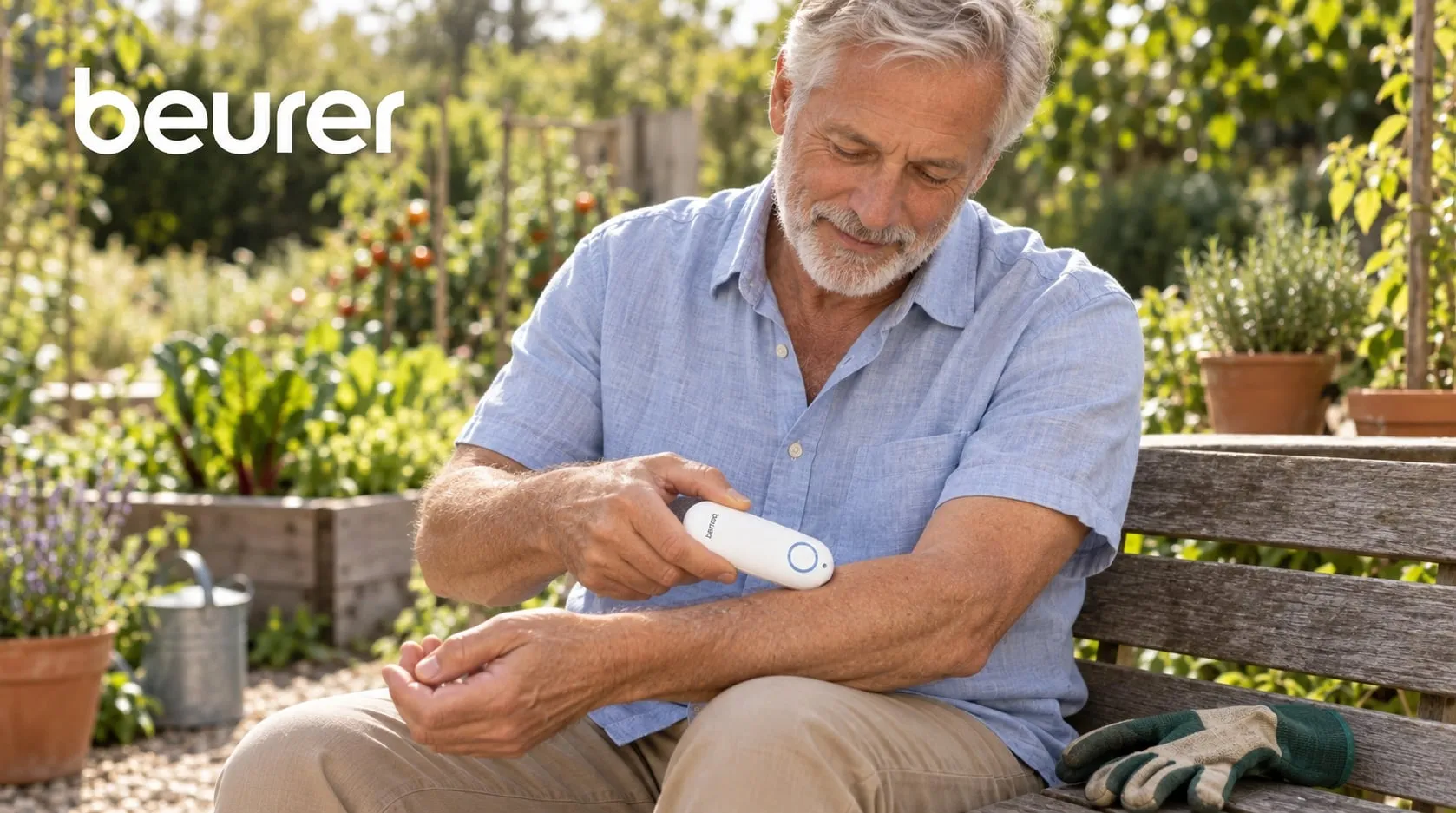
If you garden every day, your problem is not finding something that relieves a bite. It is having relief available mid-task, with soil-covered hands, no sink in reach and no 10 minutes to spare. Most bite advice assumes you can go inside, wash the area with soap and water, mix a paste and sit still. That is a kitchen routine, not a garden routine. The moment you are weeding, pruning or watering, the realistic options shrink to whatever works in seconds, one-handed, without water.
The exposure itself is stacked against you, too. Cleveland Clinic lists gardeners among the people most likely to encounter biting and stinging bugs, alongside beekeepers and anyone working in forests, gardens or overgrown fields, especially in humid weather[1]. And the timing is unhelpful: mosquitoes are most active in the evening and at night[2], which is exactly when many gardeners water, deadhead and harvest after work.
What the daily-gardener constraint rules out
·Anything that needs water you do not have, such as pastes that must be mixed and rinsed.
·Anything that needs 10 minutes of dwell time while you hold still.
·Anything that lives in the bathroom cabinet instead of on your body or your bag.
·Anything with messy creams that you cannot apply or wash off with dirty hands.
Repeated daily exposure also means repeated treatments. A remedy you would tolerate once on a camping trip becomes a chore when the bites arrive every single day. Whatever you reach for has to be repeatable without friction, or you will simply stop using it and start scratching.
What actually differs
Three families of relief compete for the spot in your garden kit, and they differ far more in speed and mess than in marketing. Here is how they compare on the constraints that matter mid-task.
Option
Time to relief
Water and mess
Carried on you
Kitchen remedies (oatmeal or baking soda paste)
Applied for 10 minutes, then wiped or washed off
Needs water to mix and rinse
No
Crushed ice or cold pack
5 to 10 minutes, several times a day
Needs a freezer and a cloth barrier
No
Over-the-counter anti-itch cream (antihistamine or hydrocortisone)
Applied to the skin as the label directs
Cream on dirty hands; reapplication needed
Sometimes
Concentrated heat device
A single press of 3 or 6 seconds, depending on the model and setting
None: no water, no paste, no cream
Yes: pocket or keychain size
The kitchen remedies are honest, evidence-backed options when you are back indoors. Healthline describes an oatmeal paste applied for 10 minutes before wiping it off, a cold pack for 5 to 10 minutes several times a day, and a baking soda paste left on for 10 minutes before washing it away[2]. Topical creams and antihistamines work per their labels and belong in the medicine cabinet. None of them, though, travels on your body or works in seconds with dirty hands. Heat is the one option Healthline lists that comes as a pocketable tool rather than a substance, alongside warm compresses. In a real-world study of more than 12,000 treated bites, concentrated heat cut mosquito-bite itch by 57% within the first minute and by 81% 5 to 10 minutes after treatment[3]. For a fuller walkthrough of every option, our complete guide to insect bite relief covers first aid, creams and heat devices in depth.
How concentrated heat relieves a bite
A heat-based bite healer works by pressing a small ceramic plate against the bite and warming the skin locally for a few seconds. Described neutrally: the concentrated warmth helps relieve itching and swelling at the site. Researchers believe the effect involves heat-activated nerve pathways, likely through the activation of TRPV1 receptors on specific nerve fibers, which appears to dampen the itch signal[4]. In plain terms, a brief, controlled heat stimulus competes with the itch signal, and the itch loses.
The evidence behind the approach is a large real-world study that tracked more than 12,000 treated bites from roughly 1,750 participants[3]. Mosquito-bite itch fell 57% within the first minute and 81% 5 to 10 minutes after treatment[3], and relief did not depend on treating quickly: bites treated hours after they happened still responded. That matters for gardeners, because you often notice a bite only after you have come inside and washed up.
Settings, timing and who can use it
·Beurer's BR60 and BR90 offer two time settings, a 3-second application for sensitive skin and a 6-second application for regular use; the keychain BR10 runs a single 3-second application. Follow the device manual for usage details.
·One press activates the ceramic plate; there is no cream, no paste and nothing to wash off.
·Suitable for ages 3 and up, and safe to use during pregnancy, which matters if you cannot take antihistamines.
·Never use heat on open wounds or skin you have already scratched open[2].
One honest limit: heat relieves the itch and swelling, it does not treat an allergic reaction or an infection, and a device is never a substitute for the care described in the section below. Used within those limits, though, a few seconds of warmth is the only option on the list that fits the mid-task moment.
Cutting bites down before they start
Relief you carry is the backstop. The first line of defense is not getting bitten as often, and for a gardener the highest-value habits are the ones that survive daily repetition.
·Use an EPA-registered insect repellent and follow the label directions closely. The EPA also advises keeping mosquitoes off exposed skin with long-sleeved shirts, long pants and socks, and tucking shirts into pants[5].
·Empty standing water from saucers, buckets, watering cans and clogged gutters, and change the water in bird baths, fountains and potted plant trays at least once a week[5]. A daily watering routine can quietly refill them.
·Be careful around shrubs, wall cavities, eaves and woodpiles, where yellow jackets, paper wasps and hornets build nests. The AAAAI notes these insects sting most often when their homes are disturbed, which is precisely what pruning does[6].
None of this needs to be elaborate. A repellent you actually reapply, sleeves on humid evenings, and a weekly walk around the yard to dump standing water will remove most of the bites from most of your gardening days. The heat device covers the bites that get through anyway.
When a bite or sting needs a doctor
Most garden bites are a nuisance, not an emergency, but the line matters and it is worth knowing calmly in advance. Anaphylaxis after a sting is a medical emergency. The American Academy of Allergy, Asthma & Immunology (AAAAI) lists its warning signs as itching and hives, swelling in the throat or tongue, difficulty breathing, dizziness, stomach cramps, nausea or diarrhea, and in severe cases a rapid fall in blood pressure. If those symptoms appear after a sting, get emergency medical treatment immediately. No bite healer, cream or home remedy belongs in that moment[6].
·A large local reaction can swell well beyond the bite itself. Cleveland Clinic notes that allergic swelling may expand to cover more than 4 inches (10 centimeters) from end to end, and that this needs a healthcare provider, especially if it keeps growing or comes with other symptoms[1].
·Infection signs to watch for: a bite that appears increasingly red, feels warm, or shows a red streak spreading outward from the site. The CDC advises seeing a healthcare provider if symptoms worsen[7].
·Also see a provider for a bite that will not heal, symptoms that get worse after a few days, or any bite near the eye.
If you have ever had a large reaction to a sting, tell your healthcare provider, because a milder reaction in the past makes a severe one more likely in the future. And if you are ever unsure whether a reaction is normal, a quick call to a healthcare professional is always the right move. Everything else in this article is about the ordinary bites, the ones that itch tomorrow and are gone by the weekend.
A clear recommendation
Measure every option against the constraint one more time. Kitchen remedies work but need water and 10 minutes. Creams work but need clean hands and a cabinet. Ice works but needs a freezer. For someone who gardens every day, the option that satisfies the constraint is concentrated heat you carry on your body, and that is exactly what the Beurer BR10 Portable Insect Bite Healer was built for. It is a compact, battery-powered device that clips to a keychain or garden bag, heats its ceramic plate on a single press, and applies concentrated warmth that helps reduce itching and swelling without chemicals or creams, for USD 19.99.
·Fits the mid-task moment: one press, a few seconds of warmth, no water, no sink, no paste to mix or rinse.
·Nothing to charge: it runs on standard batteries, so it is ready whenever the season is.
·Flexible for the whole household: suitable for ages 3 and up, including during pregnancy, with a single 3-second application on one press.
·Grounded in evidence: the heat approach it uses cut mosquito-bite itch by 57% within the first minute and 81% 5 to 10 minutes after treatment in a real-world study of more than 12,000 treated bites[8].
Clip it to the bag that already goes to the garden with you, and the next bite gets treated in the seconds it takes to stand up, not after you have marched inside with dirty hands. You can see the full details, specifications and current price on the Beurer BR10 Portable Insect Bite Healer product page. It is a small piece of kit for a large share of the summer's small miseries, and one more way we aim to keep you comfortable in your healthy. life. style.
Frequently asked questions
Does heat actually stop bug bite itching?
Yes, there is real-world evidence behind it. In a study of more than 12,000 treated bites, concentrated heat cut mosquito-bite itch by 57% within the first minute and 81% within 5 to 10 minutes after treatment. Healthline also lists targeted heat as a recognized remedy for bites, with the caution not to use heat on open wounds.
What is the fastest way to stop a mosquito bite from itching?
The CDC recommends washing the bite with soap and water, applying an ice pack for 10 minutes, and optionally a baking soda paste left on for 10 minutes. A concentrated-heat device is the fastest option for mid-task use: one press applies warmth for a few seconds with no water, paste or cleanup.
Are insect bite healers safe for children?
Beurer's bite healers are suitable for ages 3 and up. The BR60 and BR90 have a 3-second setting designed for sensitive skin and a 6-second setting for regular use; the keychain BR10 runs a single 3-second application. They are not intended for infants under 3. Follow the device manual, and see a healthcare provider if a child's reaction is severe or keeps spreading.
Can I use a heat bite healer during pregnancy?
Yes, Beurer's bite healers apply chemical-free concentrated warmth and are described as suitable for use during pregnancy, which matters because many oral antihistamines and topical steroids are ones people prefer to avoid while pregnant. As with any health decision in pregnancy, it is reasonable to confirm with your healthcare provider first.
When does a bug bite or sting need a doctor?
Call emergency services for signs of anaphylaxis: hives, swelling of the throat or tongue, trouble breathing, dizziness or stomach cramps. See a provider for swelling that spreads more than 4 inches (10 centimeters) from the sting, a spreading red streak, or symptoms that worsen or do not improve after a few days. A bite healer is not a treatment for allergic reactions.
Do bite healers work on bee and wasp stings?
The real-world heat study included bee and wasp stings and found significant itch reduction, though smaller than for mosquito bites. If a stinger is left behind, the AAAAI recommends scraping it out within 30 seconds before doing anything else, then cleaning the area with soap and water.
How do I stop getting bitten while gardening?
Use an EPA-registered insect repellent as directed, wear loose long-sleeved shirts and long pants, and consider permethrin-treated clothing and gear. In the yard, empty standing water from saucers, buckets and watering cans, and watch for wasp and hornet nests in shrubs, wall cavities and woodpiles before pruning.
For backpackers obsessed with base weight, choosing between comfort and a light pack is a constant battle. Discover why adding a chemical-free device like the Beurer Insect Bite Healer BR60 to your ultralight gear list provides immediate, clinically backed itch relief without weighing you down.

 Targeted Pain Relief
 Health Monitoring
 Bye-Bye Itch
 Rest, Relax, Recharge
 Skin Rejuvenation
 Seasonal Relief
 Muscle Relaxation
 Brighten Your Mood
 Kids Wellness & Baby Care
 Fitness Tracking
 Beauty Care
 Feminine Care